S in Morse Code: The Complete Guide to Symbol, Sound, History & Real-World Use
Morse code has survived for over 180 years not because it is old, but because it works. Even today, in a world full of smartphones and instant messaging, people still search for it every day. Among all 26 letters, one stands out for its simplicity and importance: the letter S.
S in Morse code is just three dots (···) simple, fast, and easy to recognize. It also forms the foundation of the famous distress signal SOS, used in emergencies worldwide. Whether you’re a beginner or just curious, understanding S in Morse code is the perfect place to start.
What Is S in Morse Code?
The answer is beautifully simple.
S = · · ·
Three dots. No dashes. No complex timing. Just three quick, short signals in a row.
If you have ever wondered what is S in Morse code, this is your answer. It is the shortest three-signal letter in the entire Morse code alphabet. No other letter uses exactly three dots which makes S completely unique and instantly recognizable.
The Morse Code Symbol for S
In standard International Morse Code (ITU), the symbol for the letter S is written as:
- Dots notation: · · ·
- Text notation: …
- Phonetic pronunciation: Dit Dit Dit
- Number of signals: 3 (all dots, zero dashes)
This notation is standardized worldwide. Whether you are in Pakistan, the United States, Japan, or Germany S in Morse code is always three dots.
S in the Morse Code Alphabet Table
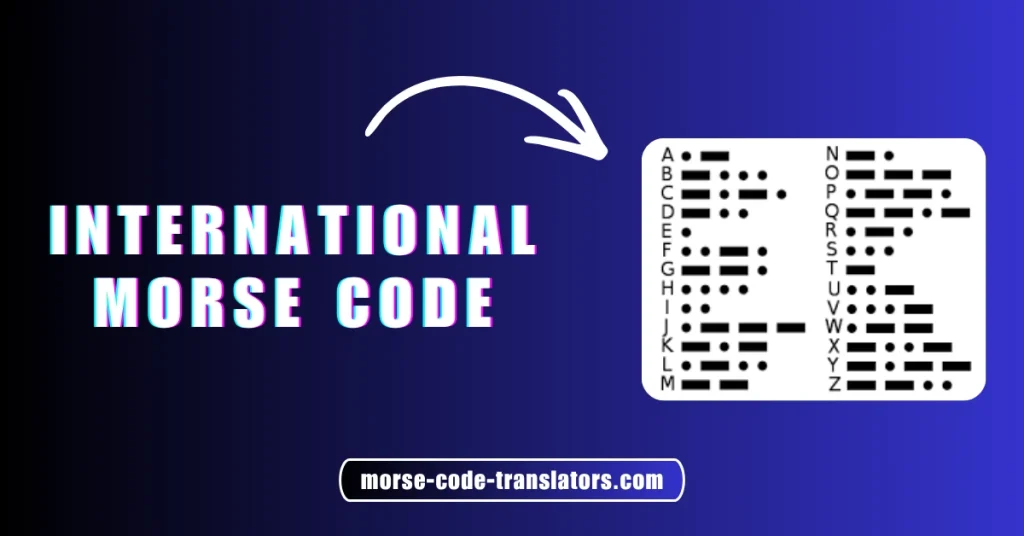
Letter | Morse Code | Signal Count |
E | · | 1 dot |
I | · · | 2 dots |
S | · · · | 3 dots |
H | · · · · | 4 dots |
O | — — — | 3 dashes |
T | — | 1 dash |
A | · — | 1 dot + 1 dash |
S follows a simple pattern in Morse code: E (1 dot), I (2 dots), S (3 dots), H (4 dots). This step-by-step order makes it easy to find and remember. Beyond SOS, learn the practical ways to transmit a distress signal using flashlights, mirrors, or sound in our survival guide: How to Signal Help in Morse Code.
How to Write S in Morse Code
One of the most practical things to learn is how to write S in Morse code across different formats and real-world situations.
Writing S on Paper
On paper, you write three dots spaced evenly:
- · ·
Keep each dot the same size. Leave equal gaps between them. There is no dash involved at all.
Writing S in Digital Text Format
When typing Morse code online, in apps, or in translators, the letter S looks like this:
…
Three periods side by side. This is the universally accepted text format used in Morse code converters, puzzle games, and learning tools.
Sending S with Sound
Make three short, equal beeps:
Beep Beep Beep
Each beep must be brief and identical in length. A “dot” in audio Morse is typically around 50–100 milliseconds at standard speed. The gap between dots equals one dot-length of silence.
Sending S with Light
Flash a torch, phone flashlight, or signal mirror three times quickly:
Flash Flash Flash
This method is used in maritime emergencies, wilderness survival, and military signaling. Three quick flashes of light = the letter S.
Sending S with Taps
Tap any surface three times with equal rhythm:
Tap Tap Tap
This is useful in walls, pipes, or any solid surface. Rescue workers and trapped miners have used this method in life-or-death situations.
Sending S with a Whistle
Blow three short, sharp whistle blasts:
Tweet Tweet Tweet
Three short whistle blasts is a recognized distress pattern in many outdoor survival contexts. It connects directly to the S in SOS.
Looking to send a secret, romantic message? Find out how to tap out I Love You in Morse Code.
How to Say S in Morse Code (Phonetics & Audio)
When Morse code operators speak the letter S aloud, they do not say “dot dot dot.” Instead, they use a phonetic system designed to match the rhythm of the signal.
The Official Phonetic Pronunciation
- Dot = “Dit”
- Dash = “Dah”
So S in Morse code is spoken as:
“Dit Dit Dit” or said quickly: “Dididit”
Why Phonetics Matter
The phonetic system was developed so operators could speak Morse code messages out loud during training and live radio sessions. The short, clipped “dit” sound naturally mirrors the brief duration of a dot signal. This helps operators internalize rhythm rather than simply memorizing patterns.
How to Practice Saying S
Say “dididit” three times quickly in a row. Notice how the rhythm creates a staccato pattern three identical beats with no variation. Once you can hear that rhythm in your head, you will never forget that S = · · ·.
Numbers follow a very specific, logical pattern in Morse code. Memorize the sequence quickly by studying Morse Code Numbers.
The History of S in Morse Code
Understanding where Morse code came from helps explain why S received such a simple pattern.
Samuel Morse and Alfred Vail
Morse code was not invented by Samuel Morse alone. Alfred Vail, an engineer working with Morse in the 1830s and 1840s, developed the actual dot-and-dash alphabet. Vail’s key insight was to assign shorter codes to the most frequently used letters in the English language.
He reportedly visited a local print shop and counted how many metal type pieces existed for each letter. The most common letters had the most pieces and those got the shortest Morse patterns.
Why S Got Three Dots
The letter S is the seventh most common letter in English. It appears in plurals, verb endings, and countless everyday words. Because it appears so frequently in written communication, S was assigned a code that could be sent quickly three short signals with no dashes.No dashes means no waiting. No long signals. No timing confusion. S is pure speed.
Standardization by the ITU
The original American Morse code (used on land telegraph lines) was different from the International Morse code used everywhere else. In 1865, the International Telegraphy Congress in Paris standardized the code. The International Telecommunication Union (ITU) later adopted this standard.
The three-dot code for S has remained completely unchanged through every revision. It was part of the original system and has never needed to change because it was already perfect.
S in the Famous SOS Signal
No section about S in Morse code would be complete without a deep look at SOS the most recognized distress signal in human history.
What SOS Looks Like in Morse Code
- · · — — — · · ·
Which breaks down as:
- S = · · · (three dots)
- O = — — — (three dashes)
- S = · · · (three dots)
The full signal is nine elements long three short, three long, three short creating a perfectly symmetrical pattern that is unmistakable even through radio noise, weak signals, and interference.
Why S Was Chosen for SOS
The letter S was selected for this signal deliberately. Here is why:
- It is the fastest letter to transmit (three short signals)
- It stands out clearly in noisy conditions
- It can be sent repeatedly without fatigue
- It is instantly recognizable even at low skill levels
- It creates a clear rhythmic contrast with the three dashes of O
The symmetry of SOS short-short-short, long-long-long, short-short-short is not accidental. It was engineered for clarity in the worst possible conditions.
The SOS Myth It Does Not Stand for Anything
A common misconception is that SOS stands for “Save Our Souls” or “Save Our Ship.” In reality, SOS is not an abbreviation for anything. The three letters were chosen purely because the combination — · · · — — — · · · — created the most recognizable and transmittable distress pattern in Morse code.
SOS was adopted as the international maritime distress signal at the 1906 Berlin Radiotelegraphic Convention and became globally standard by 1908.
How to Send SOS in Real Life
You can send SOS using any method sound, light, or taps:
- Sound: Beep-beep-beep (pause) beeeep-beeeep-beeeep (pause) beep-beep-beep
- Light: Flash-flash-flash (pause) FLASH-FLASH-FLASH (pause) flash-flash-flash
- Taps: Tap-tap-tap (pause) TAP-TAP-TAP (pause) tap-tap-tap
The key difference: short signals for S, long signals for O.
Morse Code Timing Rules for S
Timing is everything in Morse code. Sending three dots is easy but sending them correctly requires understanding the formal timing structure.
The Standard Timing Unit
All Morse code timing is based on a single “unit” the length of one dot. Everything else is a multiple of this unit.
Element | Duration |
Dot (·) | 1 unit |
Dash (—) | 3 units |
Gap between dots/dashes within a letter | 1 unit |
Gap between letters | 3 units |
Gap between words | 7 units |
Timing Breakdown for S
When sending S (· · ·), the timing works like this:
- Dot 1: 1 unit (signal on)
- Gap: 1 unit (silence)
- Dot 2: 1 unit (signal on)
- Gap: 1 unit (silence)
- Dot 3: 1 unit (signal on)
Total time for S = 5 units (3 dots + 2 internal gaps)
This makes S one of the fastest letters to transmit. Only E (1 unit) and I (3 units) are faster.
Speed in Words Per Minute (WPM)
Morse code speed is measured in words per minute (WPM), using the word “PARIS” as the standard (50 units per word). At 5 WPM beginner speed one dot lasts about 240 milliseconds. At 20 WPM (intermediate), one dot lasts around 60 milliseconds.S can be transmitted completely in under half a second at intermediate speed.
S in Morse Code for Beginners
If you are just starting to learn Morse code, S is traditionally the very first letter taught and for excellent reasons.
Why S Is the Best Starting Letter
Teachers and training programs worldwide start with S because:
- It uses only dots no dashes to confuse the timing
- Three signals create a clear, memorable rhythm
- It builds confidence quickly
- It is part of the famous SOS signal, giving it immediate real-world meaning
- It sounds satisfying when sent: “dit-dit-dit”
Common Beginner Mistakes with S
When learning to send or receive S, beginners often make these errors:
- Uneven dot length: All three dots must be exactly the same duration. A longer dot sounds like a dash.
- Wrong gap timing: The gap between each dot should equal one dot-length. Too long a gap makes S sound like three separate E’s.
- Rushing: Beginners often speed up after the first dot. Keep a steady, even rhythm.
- Inconsistent pressure: When tapping, use the same pressure for all three taps.
Memory Tricks for S
The best way to remember S = · · · :
- Think of the letter S as “Simple just three dots”
- Say “dit-dit-dit” aloud three times rapidly it sounds like a light machine
- Connect it to SOS: if you can tap three dots, you can signal for help
- Remember the progression: E (1), I (2), S (3), H (4) one more dot each time
Practice Exercises for S
Practice S using these simple daily exercises:
- Tap your finger on a desk three times while saying “dit-dit-dit”
- Use a Morse code app and listen to S until you recognize it instantly
- Flash your phone’s torch three times, then try to receive it from a friend
- Write S five times in dots: · · · / · · · / · · · / · · · / · · ·
- Try sending short words that contain S: SOS, SUN, SEA, YES, USE
Beginner Mistakes That Slow Down Morse Code Learning
Modern technology has made learning Morse code more accessible than ever. You no longer need to memorize charts from memory before you can begin.
How Online Morse Code Translators Work
A Morse code translator takes text you type and instantly converts it to dots and dashes. When you type the letter S, the tool outputs:
…
Most good translators also allow you to:
- Hear the audio: listen to the actual beep pattern for S
- See the signal: watch a visual light flash the pattern
- Copy the result:share the Morse text with others
- Reverse translate: type dots and dashes and receive the letter
What to Look for in a Morse Code Learning App
When choosing a Morse code app or tool, look for these features:
- Audio playback with adjustable speed
- Visual flash/light mode
- Mobile-friendly interface
- Full alphabet and number support
- Interactive quizzes or training mode
- Support for real-time typing feedback
Using Google’s Morse Code Trainer
Google developed an official Morse code trainer (available at g.co/morse) originally designed to integrate with Gboard Google’s keyboard for Android. The trainer teaches individual letters starting with the simplest patterns. S with its three dots is among the earliest letters introduced in the program.
This tool was developed as part of Google’s accessibility initiative to help people with physical disabilities communicate using Morse code input.
Practical Ways to Send S in Morse Code
Beyond training exercises, real-world use of Morse code S spans multiple fields and situations.
Using a Telegraph Key
The traditional Morse key a spring-loaded lever sends a signal as long as it is pressed. For S, press the key down three times in quick succession with equal, brief pressure. Release the key completely between each press.
Amateur radio operators still use this method today in “CW” (continuous wave) mode, which uses Morse code as the transmission format.
Using a Smartphone Flashlight
Your phone’s flashlight is one of the most practical Morse code tools available right now. Open your flashlight app and toggle it on and off three times quickly. This simple action communicates S to anyone trained in Morse code.
In a power outage or emergency, a smartphone’s torch can signal S or the full SOS over long distances at night.
Amateur Radio (CW Mode)
In amateur (ham) radio, CW (Continuous Wave) mode transmits Morse code as audio tones. The letter S sounds like three short beeps. Many ham radio operators still prefer CW over voice because it:
- Works at lower signal strength
- Cuts through interference
- Requires narrower bandwidth
- Can be decoded by trained human ears
Knocking on Walls or Pipes
Three knocks on a wall = S in Morse code. This is not just movie dramatization it is a real survival technique used in mine rescues, earthquake collapses, and building fires. Rescue teams are trained to listen for rhythmic signals, and three short knocks is one of the clearest patterns to detect.
Blinking Your Eyes
For individuals with severe physical disabilities, eye-blink Morse code is a genuine communication tool. Three short blinks = S. This method has allowed people with conditions like locked-in syndrome to communicate full sentences using only eye movement.
S in Morse Code Crossword Clues and Pop Culture
Morse code is not just a technical skill. It lives in popular culture in surprising ways.
S in Morse Code NYT Crossword Clues
The New York Times crossword puzzle has featured Morse code references many times. Common clues involving S include:
- Three dots, in Morse → S
- Morse code for distress, first letter→ S
- Dit-dit-dit, in telegraphy → S
- Start of a maritime distress signal → S
When you see any NYT crossword clue referencing three dots, a distress signal, or “dit-dit-dit,” the answer is always S.
S in Morse Code in Movies and TV
Morse code appears in countless films and television series. The letter S is often shown first because audiences can grasp three quick signals more easily than complex sequences. Notable appearances include:
- The Imitation Game (2014): Alan Turing’s team decodes German Morse transmissions, with simple letters like S forming the building blocks of decryption
- Interstellar (2014): Morse code plays a central role in the film’s plot, with short signals (including S-like patterns) representing communication across dimensions
- Hacksaw Ridge (2016): Military radio communication with Morse code features throughout the film
- Stranger Things: The lights-flashing communication sequence mirrors Morse code principles, with short flashes representing dot-signals
Morse Code Tattoos and Jewelry
Morse code tattoos have become popular in recent years. The letter S represented as three small dots is one of the most requested Morse patterns. People use it to represent:
- Their initial (the letter S)
- A hidden personal message
- A connection to SOS and survival themes
- Minimalist aesthetic with deep meaning
Three small dots tattooed in a row is a clean, subtle, and meaningful design that carries centuries of history.
Real-World Uses of S in Morse Code Today
Even in the digital age, Morse code especially the letter S (···) remains useful across aviation, radio, military, accessibility, and emergency situations.
Aviation & Air Traffic
Morse code identifiers are still used in navigation beacons like NDBs and VORs. Pilots recognize patterns such as S (···), and some systems continue to transmit Morse as a backup to voice communication.
Amateur (Ham) Radio
Morse code (CW mode) is widely used by radio operators. The letter S appears in signals like SOS (distress), 73s (best regards), and SK (end of transmission).
Military Training
Many armed forces still teach Morse code for backup communication when digital systems fail or are jammed. The simple three-dot S is often one of the first signals learned.
Accessibility Technology
Morse code enables communication through simple inputs like sip-and-puff devices, single switches, or eye blinks. S (three short signals) is one of the easiest and most practical patterns.
Accessibility Emergency Preparedness
Learning S is essential for sending SOS in emergencies. It allows you to signal for help using light, sound, or taps even without modern devices.
Conclusion
The letter S in Morse code is simple and powerful. It is just three dots (···) no dashes, easy to learn, and easy to remember.From early telegraph systems to the famous SOS signal, S has played an important role in communication. Whether you are learning for fun, emergencies, or radio use, this is the perfect place to start.
S = ··· (Dit Dit Dit)
Three dots simple, clear, and important.
Frequently Asked Questions
What Is S in Morse Code?
S in Morse code is three dots: · · · (or …). It is very simple because it uses only short signals (dots) and no dashes.
How Do You Say S in Morse Code?
You say it as Dit Dit Dit or quickly dididit. Each “dit” means one short dot sound.
What Does · · · Mean in Morse Code?
· · · means the letter S. This is the same all over the world.
Why Is S Used in SOS?
S is used because it is fast and easy (three short signals). It also matches well with O (three long dashes), making SOS (··· — — — ···) clear and easy to recognize.
What Is the Crossword Clue for S in Morse Code?
Common clues are Three dots, Dit-dit-dit, or Start of SOS.The answer is always S.
What Is the Difference Between S and H in Morse Code?
- S = · · · (3 dots)
- H = · · · · (4 dots)
Easy trick: S = Short = 3 dots.
How Long Does It Take to Learn S in Morse Code?
You can learn S in a few minutes.To recognize it by sound may take a few hours of practice.